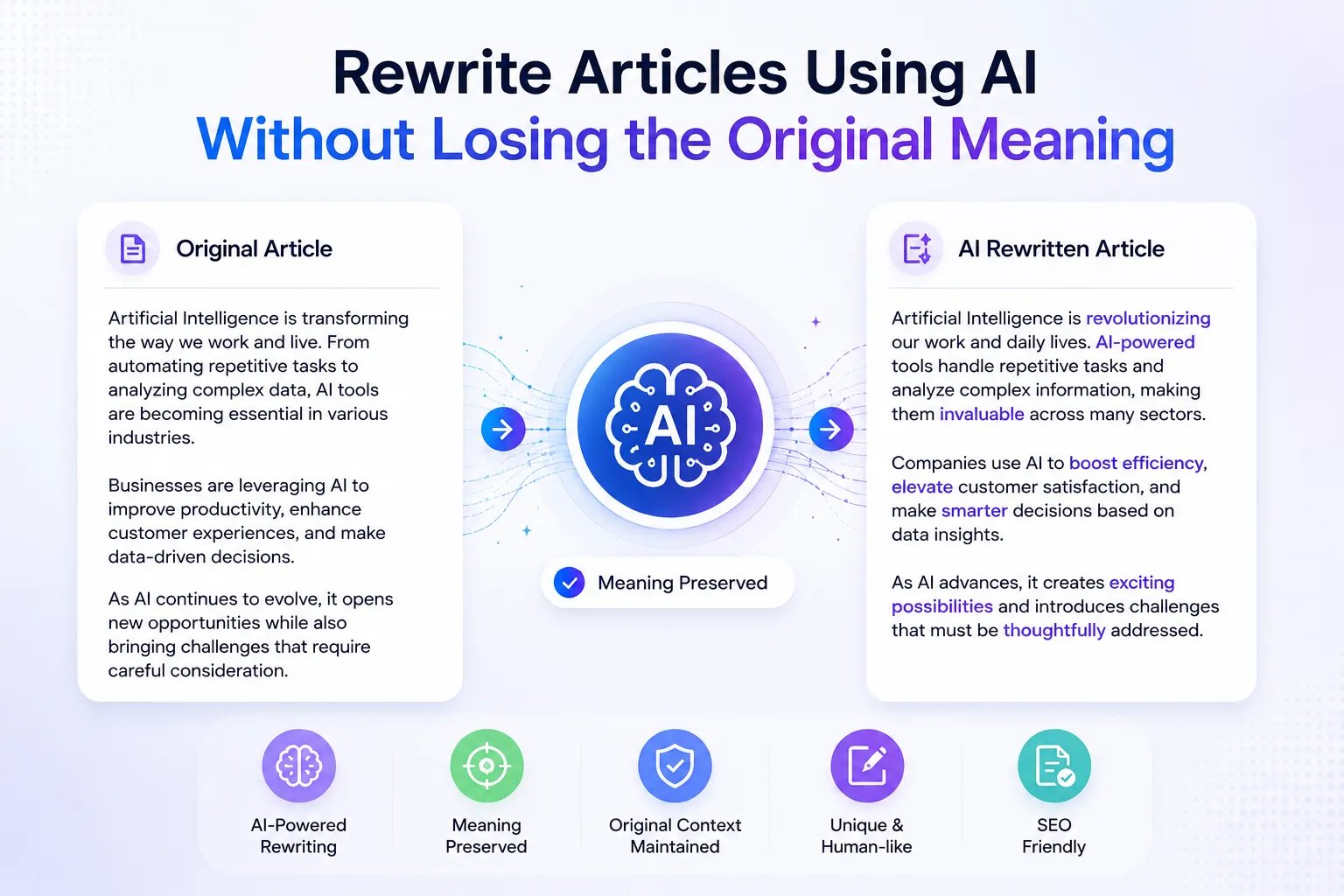
Have you ever copied a brilliant 1,000-word article, pasted it into an AI tool, and watched in horror as it spewed out a robotic, nonsensical wall of text? Well, you’re not alone.
While everyone is using basic paraphrasing tools, the biggest challenge in 2026 is maintaining content originality and the core message. AI destroys context when you just hit the “rewrite” button. It changes important facts and completely eliminates human emotion.
If you want to dominate search engines, you’ll have to learn how to use ChatGPT to rewrite text without losing context.
The “Chunking Method”: Best Way to Rewrite Long Articles
Most beginners fail because they feed entire articles into a free AI article spinner that doesn’t understand anything. When you feed too much text to an AI, it gets overwhelmed.
Why AI Gets Confused When Rewriting 1000+ Words
The Language Model’s “Attention Span” is limited. They fall victim to AI confusion when you ask them to rewrite 1,500 words at a time. They start making up fake statistics, skip important paragraphs, and completely lose the structure of the content.
Step-by-Step: Breaking Content into 300-Word Chunks
If you’re looking for the best AI paraphrasing tool for long articles, the secret isn’t just in the tool—it’s in the method.
- Break it down into small chunks: You should divide your original article into small “chunks” of 3-4 paragraphs (each of about 300 words).
- Rewrite section by section: Feed these sections to the AI one by one.
- Combine them: You’ll need to merge the rewritten sections in your editor.
This guarantees that you maintain the same format when rewriting content with ChatGPT, ensuring that no H2 headings or bullet points are accidentally removed.
It’s this precise attention to detail and formatting that helps you outperform automated systems. If you’re currently looking for a job, you should read our guide on 7 Free AI Resume Builders That Help You Land a Job Faster to ensure your formatting is correct.
Prompt Engineering: AI Prompts to Rewrite Articles Like a Human
A smart SEO knows that the output is only as good as the input. Basic prompts get basic results. To truly make AI text sound human, you have to master prompt engineering.
“Tone Matching” Prompt for Perfect Reframing
If you want to know how to reframe text without losing the original tone, you have to explicitly tell the AI what that tone is.
Copy-Paste Tone Prompt:
“I’m going to give you a paragraph. First, analyze its tone (e.g., informal, authoritative, witty). Then, rewrite the paragraph using different words and sentence structures, but maintain the exact same tone and core meaning. Do not sound robotic: [Insert text]”
Whatever you write. It’s important to adopt the right tone for it. Learn how we apply this strategy in our guide How to Write a Perfect Cover Letter Using AI That Sounds 100% Human
How to preserve facts, quotes, and statistics
The biggest risk with AI is that it changes numbers. To prevent this, you should use a strict rule prompt
Fact-preservation copy-paste prompt:
“Rewrite this text to make it unique and engaging. Hard rule: Do not change any numbers, statistics, percentages, proper names, or direct quotes. The original meaning must remain 100% intact: [insert text]”
Top Tools: Best AI Paraphrasing Tool for Long Articles in 2026
Not all NLP models are created equal. Here’s how the top tools work when you need to rewrite paragraphs for AI for free without changing the meaning.
| Tool Name | Best Used For | Context Retention Score | Plagiarism Safe? |
|---|---|---|---|
| Claude AI | Long articles & Deep Context | 9.5 / 10 | Yes |
| ChatGPT (GPT-4) | Fast rephrasing & formatting | 8.5 / 10 | Yes |
| QuillBot | Sentence-by-sentence tweaks | 7.0 / 10 | Check manually |
If you’re wondering what the best AI tool is for rephrasing articles without changing their meaning, Claude AI is currently in first place for maintaining a natural, empathetic, and highly context-aware flow.
Want to discover more game-changing software? You should check out our complete master list of Free AI Tools and SaaS for Beginners 2026
How to Paraphrase an Article Using AI to Avoid Plagiarism & SEO Penalties
Google doesn’t penalize AI content; it penalizes spammy, useless content. To safely publish your rewritten article, you must follow this essential three-step checklist.
- Check for plagiarism: Always run your final draft through Copyscape or Grammarly’s premium checker to ensure it doesn’t exactly match any source.
- Check your readability score: You should use the Hemingway app. If your AI has used complex jargon like “delve” or “tapestry,” you should manually rewrite those words to keep the grade level accessible.
- Verify grammar: AI sometimes creates awkward sentence structures when rewriting.
Don’t pay for premium editors. You should use the tools listed in our guide to polish your final draft for free: 7 Best Free AI Grammar Checkers That Are Better Than Grammarly
People Also Ask: Frequently Asked Questions
Can AI rewrite an article without plagiarism?
But only if you instruct it to change the “sentence structure” rather than just replacing words with basic synonyms. You should always use a plagiarism checker before publishing.
Which AI is best for rephrasing articles without losing meaning?
For long-form content, Claude AI and ChatGPT (GPT-4) are best because they understand deeper context. QuillBot is very effective for one-paragraph revisions.
How do I stop AI from changing facts when rewriting?
You have to give the AI a strict limit. You should add to your prompt, “Strict rule: Do not add external information, and keep all names, quotes, and statistics exactly as they appear in the original text.”
Will Google penalize content rewritten by AI?
Google’s official guidelines state that they don’t penalize AI content as long as it provides the reader with high-quality, helpful information. They penalize low-quality spam and keyword stuffing.
How to rewrite long articles with ChatGPT?
You should never paste 1,000 words at once. You should use the “chunking method.” Divide your article into 300-word sections and ask ChatGPT to rewrite them one by one to preserve the original meaning and format.